
Precision Farming Sensors & Irrigation Scheduling: Calculating ET0 and Water Balance
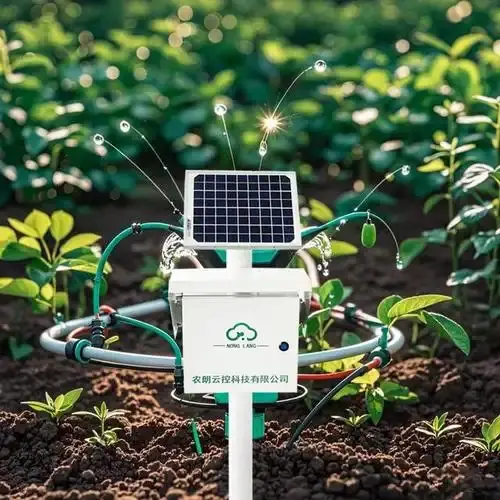
Freshwater availability is among the greatest operational constraints facing commercial agriculture today. Over-irrigation leaches costly fertilizers into groundwater tables and creates root asphyxiation, while under-irrigation induces severe drought stress and slashes crop yield.
By pairing precision farming sensors with automated control equipment, commercial farms can implement scientific irrigation scheduling based on real-time atmospheric demand rather than rigid calendar timers.
1. The Science of Evapotranspiration (ET)
Crop water loss consists of two simultaneous processes: soil surface evaporation and plant stomatal transpiration, collectively termed Evapotranspiration ($ET$).
The standard reference index recognized globally is the FAO-56 Penman-Monteith equation, which calculates reference evapotranspiration ($ET_0$) using real-time atmospheric variables gathered by an on-site smart agricultural weather station:
- Net Solar Radiation: The primary energy driver converting liquid water into water vapor within plant leaves.
- Air Temperature & Relative Humidity: Establishing the vapor pressure deficit (VPD) between the inner leaf cavity and surrounding air; learn how to measure these without solar bias in our Temperature, Humidity & Pressure Sensor Guide.
- Wind Velocity: Wind sweeps away the humid boundary air layer surrounding crop foliage, accelerating moisture loss. Deploying an aerodynamic, zero-maintenance instrument like the VT-WDS2E Ultrasonic Wind Sensor ensures continuous boundary-layer tracking.
2. Closed-Loop Water Balance Calculation
Automated irrigation systems balance field soil water reserves using a simple dynamic formula:
$$Delta S = Rain - (ET_0 imes K_c)$$
Where $K_c$ represents the specific crop coefficient varying with physiological growth stage, and $Rain$ represents precipitation measured accurately by an on-site tipping bucket rain gauge. When accumulated soil water depletion crosses the Management Allowed Depletion (MAD) threshold, the station's control unit automatically triggers field irrigation valves.
3. Field Telemetry & Automation Architecture
To close the loop, environmental readings must reach field controllers without requiring manual daily inspection. Deploying a dedicated solar-powered telemetry unit ensures uninterrupted data streaming; read our complete blueprint on Solar-Powered Weather Stations & Data Loggers.
Conclusion
Adopting sensor-driven irrigation scheduling typically reduces irrigation water and pumping electricity costs by 20% to 40% while maximizing fruit sizing and crop consistency. Contact the Virtue Instrument agronomy team to configure an automated weather and irrigation sensing system tailored for your farm.