
Vineyard Weather Stations: Managing Frost Risk, Powdery Mildew & Irrigation Microclimates
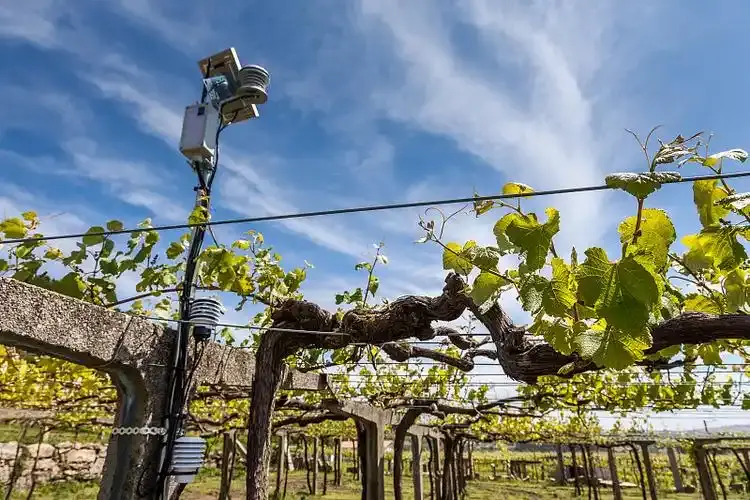
In high-value viticulture, regional weather forecasts are insufficient for managing harvest quality. Due to complex hillside topography, thermal cold-air drainage, and varying canopy density, microclimate conditions can fluctuate dramatically across a single estate. A valley floor plot may experience damaging radiation frost at dawn while an elevated hillside block remains safely above freezing.
Deploying dedicated, hyper-local vineyard weather stations equips vineyard managers, agronomists, and winemakers with plot-level microclimate data. Real-time atmospheric metrics eliminate guesswork during critical phenological growth stages, optimizing frost mitigation, spray applications, and water consumption.
1. Spring Frost Protection & Cold-Air Drainage Monitoring
Spring frost during budburst and early shoot development is one of the most severe financial threats to commercial vineyards. A brief temperature dip to -1°C can kill tender green buds and devastate annual yields.
Vineyard terrain naturally channels dense cold air into low-lying hollows (cold-air pooling). A reliable frost-alert system requires:
- Precision Ambient & Wet-Bulb Temperature: When evaporative cooling occurs during sprinkler frost protection, wet-bulb temperature dictates true tissue freezing risk. Learn how multi-plate shields protect sensors from thermal bias in our guide on Temperature, Humidity & Pressure Sensors.
- Real-Time Low-Latency Alarms: Automated SMS and telemetry alerts trigger frost mitigation equipment (wind machines, smudge pots, or overhead micro-sprinklers) before critical thresholds are reached.
- Thermal Inversion Tracking: Wind machines rely on mixing warmer inversion layers (10 meters aloft) with ground-level freezing air. Verifying calm winds and thermal inversions ensures machinery is run only when effective.
2. Disease Risk Modeling: Controlling Powdery & Downy Mildew
Fungal pathogens like Powdery Mildew (Erysiphe necator), Downy Mildew (Plasmopara viticola), and Botrytis bunch rot thrive within specific microclimatic windows. Traditional calendar-based chemical spray programs often lead to over-application, increasing chemical costs, soil compaction, and environmental runoff.
Modern viticulture software calculates disease severity indices (such as the Gubler-Thomas Powdery Mildew Model) using empirical weather sensor data:
- Canopy Temperature & Relative Humidity: Powdery mildew conidia germinate optimally between 20°C and 27°C with moderate-to-high relative humidity, while growth halts above 35°C.
- Leaf Wetness Duration: Downy mildew and Botrytis require free water film on leaf and cluster surfaces for spore germination. Pairing leaf wetness sensors with microclimate loggers flags exact infection events, enabling targeted post-infection fungicide sprays rather than weekly broad-spectrum spraying.
Integrating these biological thresholds into broader agricultural systems is explained in detail in our Smart Agricultural Weather Station Selection Guide.
3. Spray Drift Mitigation with Maintenance-Free Ultrasonic Wind Sensing
Fungicide and nutrient spraying requires strict environmental compliance. High winds cause costly chemical drift onto neighboring properties or non-target crops, while complete thermal dead-calms risk volatile droplet suspension.
Traditional mechanical cup anemometers frequently fail in agricultural environments due to airborne road dust, chemical spray residues, and sulfur deposits that gum up internal mechanical bearings. Upgrading to a solid-state instrument like the VT-WDC2E Ultrasonic Anemometer provides major operational advantages:
- Zero Moving Parts: No bearings to lubricate, seize, or replace when exposed to seasonal sulfur dusting and vineyard tractor dust.
- 15 mA Ultra-Low Power Consumption: Runs effortlessly on small 5W-10W solar panels and compact lithium batteries throughout dark, overcast winter months.
- Instantaneous Gust & Direction Tracking: Supports RS485 Modbus-RTU and SDI-12 integration into agricultural IoT gateways and automated spray-rig consoles.
4. Evapotranspiration (ET0) & Deficit Irrigation Scheduling
Premium wine grape production relies on regulated deficit irrigation (RDI) to control vegetative canopy vigor and concentrate phenolic anthocyanins, sugars, and tannins in the fruit. Over-watering creates overly dense, disease-prone canopies and diluted grape flavors.
By measuring net solar radiation, temperature, relative humidity, and aerodynamic boundary wind velocity, a vineyard weather station calculates real-time reference crop evapotranspiration ($ET_0$). When combined with root-zone soil moisture arrays, vineyard managers can replenish only the specific volume of water lost through canopy transpiration. Discover how ET-driven water balancing operates in our practical guide on Precision Farming Sensors & Irrigation Scheduling.
5. Siting & Sensor Density Recommendations for Vineyards
| Installation Zone | Primary Monitored Risk | Recommended Sensor Package |
|---|---|---|
| Valley Floor / Bottom Hollow | Severe Radiation Frost Pooling | High-precision shielded Temp/RH, surface temp probe |
| Within Mid-Canopy Rows | Fungal Disease & Micro-humidity | Canopy Temp/RH, Leaf Wetness, Soil Moisture probe |
| Ridge Top / Open Tower | Macro ET0, Spray Drift, Inversion Layer | VT-WDC2E Ultrasonic Anemometer, Solar Radiation, Rain Gauge |
Conclusion
From automated early morning frost alarms to optimized spray timing and water-saving irrigation curves, localized vineyard weather stations represent an indispensable tool for modern precision viticulture. Replacing mechanical failure points with solid-state ultrasonic instruments ensures high reliability across multiple growing seasons.
Looking to equip your vineyard estate with dependable microclimate hardware or integrate customized OEM sensors into your viticulture management software? Contact the Virtue Instrument engineering team to request technical documentation, protocol integration support, and volume quotes.