
Optimizing Solar PV Performance Ratio (PR): The Critical Meteorological Sensors You Need
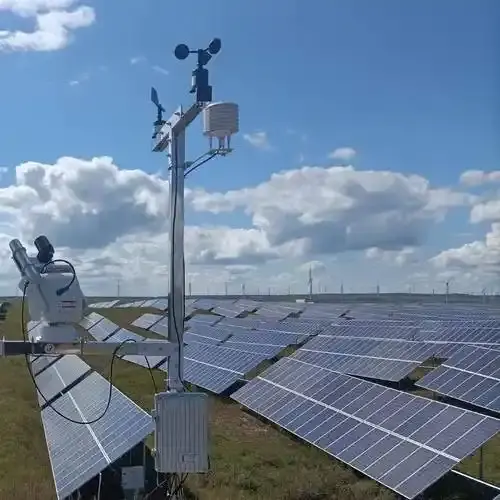
For utility-scale solar asset owners, EPC contractors, and financial investors, the Performance Ratio (PR) is the supreme benchmark of asset health. It measures the relationship between actual AC energy output delivered to the grid and the theoretical energy the solar plant should have produced based on available solar irradiance.
A lower-than-expected PR triggers financial penalties, warranty claims, and investor scrutiny. However, you cannot diagnose whether underperformance stems from inverter clipping, soiling losses, or cabling degradation unless your baseline environmental parameters are measured with scientific precision. Review our engineered meteorological monitoring systems for solar and wind farms to maintain rigorous measurement compliance.
1. The Formula: How Weather Parameters Govern the PR Calculation
Under international standard IEC 61724-1 (Photovoltaic System Performance Monitoring), temperature-corrected Performance Ratio evaluates normalized yields:
$$PR = \frac{Y_f}{Y_r} = \frac{E_{AC} / P_0}{H_{POA} / G_{STC}}$$
Where:
- $E_{AC}$: Total AC energy generated over a defined timeframe (kWh).
- $P_0$: Total installed DC peak capacity at Standard Test Conditions (kWp).
- $H_{POA}$: Total incident irradiation in the Plane of Array ($kWh/m^2$).
- $G_{STC}$: Reference irradiance at STC ($1000 W/m^2$).
If your irradiance or environmental sensors register erroneous data, your calculated PR will be artificially inflated or depressed, triggering false operations alarms or obscuring real equipment failures.
2. Key Meteorological Sensors Required on Commercial PV Plants
1. Plane-of-Array (POA) & Global Horizontal Irradiance (GHI)
Thermopile pyranometers (ISO 9060 Class A or Class B) quantify solar resource availability. Measuring POA irradiance ensures tracking and fixed-tilt planes are evaluated against the true photons striking the active cell surfaces.
2. Back-of-Module Temperature Probes
Crystalline silicon PV cells exhibit a negative temperature coefficient: for every degree Celsius rise above 25°C, electrical efficiency drops by roughly 0.35% to 0.45%. Accurate four-wire PT100/PT1000 surface sensors taped securely to the backsheet are required to calculate temperature-adjusted expected yields.
3. Ambient Air Temperature & Relative Humidity
Sensors housed in multi-plate naturally ventilated radiation shields record true boundary air temperatures, providing the baseline for thermal dissipation models. Review radiation shield dynamics in our Temperature, Humidity & Pressure Sensor Guide.
4. Convective Wind Speed & Direction (The Cooling Factor)
Wind velocity is frequently underestimated in solar plant modeling. Convective air movement across the front glass and rear backsheet drives natural cell cooling. On a hot summer day with 1,000 W/m² irradiance, an 8 m/s wind can cool module temperatures by over 15°C compared to a calm day, boosting power generation by 5% to 7%.
3. Why Low-Power Solid-State Ultrasonic Sensors Win in Solar Scenarios
Integrating environmental sensors into remote solar combiner boxes or string monitoring stations demands hardware reliability:
- Ultra-Low Power Draw: The VT-WDC2E Ultrasonic Anemometer consumes just 15 mA @ 5 VDC, operating seamlessly from 24VDC DC-bus tap-offs without overburdening auxiliary monitoring UPS systems.
- Immunity to Soiling & Dust: Unlike rotating mechanical cups that seize up from ambient dust in arid desert solar farms, ultrasonic acoustic transducers maintain operational accuracy through severe sandstorm conditions.
- Direct Modbus RS485: Plugs directly into inverter data loggers, SCADA RTUs, or edge IoT gateways without external signal conditioners.
Conclusion
Precise meteorological sensors transform raw PV generation metrics into bankable, actionable Performance Ratio analytics. Eliminating mechanical failure points ensures your baseline data remains rock-solid for the 25-year operational lifecycle of the plant.
Upgrading your utility solar monitoring stations or specifying sensors for an upcoming balance-of-system (BOS) tender? Contact our technical sales team to request compliance documentation, RS485 register specifications, and factory-direct volume pricing.