
Wind Monitoring for Solar Trackers: Mitigating Aeroelastic Instability with Fast-Response Anemometry
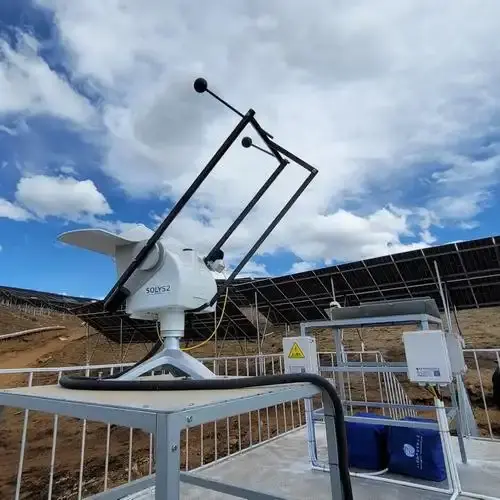
Utility-scale solar farms increasingly deploy single-axis horizontal trackers to boost daily energy yields by 15% to 25% over fixed-tilt systems. However, long rows of motorized PV tables present massive aerodynamic surface areas vulnerable to destructive wind loading, dynamic vortex shedding, and torsional flutter.
When unexpected high-speed gusts strike an angled tracker row, aerodynamic lifting forces can twist the drive tube, rip modules from their purlins, and collapse entire tracker blocks. Preventing catastrophic loss requires integrating ultra-responsive atmospheric monitoring within utility-grade renewable energy weather monitoring solutions.
1. The Aeroelastic Threat: Torsional Galloping & Flutter
Structural failure on solar tracker installations rarely stems from steady laminar winds alone. The primary structural hazard is aeroelastic instability—a resonant feedback loop where aerodynamic gust pulses align with the natural torsional frequency of the tracker structure.
- Vortex Shedding: Air traveling over tilted solar arrays generates alternating vortices on the leeward edge, causing low-frequency oscillation.
- Torsional Galloping: If wind speed exceeds a critical threshold while the tracker remains tilted at high pitch (e.g., 45° to 60°), torsional vibration amplitudes escalate rapidly until mechanical linkages sheer.
- The Critical Stow Window: Tracker motors require 60 to 180 seconds to drive extended module rows into a safe horizontal defensive stow position (0° tilt). The wind sensing system must detect approaching gusts instantaneously to allow adequate transit time.
2. Why Mechanical Cup Anemometers Risk Tracker Failure
Historically, tracker manufacturers mounted basic 3-cup mechanical anemometers to trigger stow routines. In utility field environments, mechanical units present critical failure modes:
- Mechanical Inertia (Moment of Inertia): Spinning cups have physical mass. They accelerate slowly during sudden explosive gusts, creating measurement latency that delays emergency stow commands.
- Bearing Wear & Sand Seizure: Desert utility-scale solar installations face relentless airborne dust and sandstorms. Fine particulates penetrate mechanical bearing housings, increasing rotational friction and causing under-reporting of true gust velocities.
- Single-Point Vulnerability: A seized mechanical bearing leaves tracker controllers blind, preventing automatic stow maneuvers during severe frontal wind events.
3. Solid-State Ultrasonic Anemometry for Real-Time Stow Control
Upgrading tracker weather stations to solid-state sensors like the VT-WDC2E Ultrasonic Anemometer eliminates mechanical lag and downtime:
- Zero Rotational Inertia: Ultrasonic time-of-flight (TOF) acoustic pulses sample the measurement gap at frequencies up to 10 Hz, recording instantaneous peak gust velocities without inertia lag.
- Sealed Solid-State Housing: With no rotating cups or slip rings, the IP65-rated ASA body completely seals internal electronic elements against abrasive desert sands and salt fog.
- Direct PLC Communication: Standard Modbus-RTU over RS485 interfaces directly with tracker controller PLCs, transmitting wind speed, azimuth direction, and sensor health flags over industrial daisy-chain networks.
4. Array Siting & Redundancy Best Practices
On large solar facilities spanning hundreds of hectares, micro-topography causes localized gust variation across different tracker blocks. Recommended siting guidelines include:
- Boundary Monitoring: Place ultrasonic anemometers on the perimeter rows facing prevailing storm fronts to establish an early-warning buffer.
- Internal Mast Elevation: Anemometers must be elevated at least 2.0 to 2.5 meters above the highest rotation peak of the panels to avoid localized turbulence shedding from neighboring rows.
- Fail-Safe Logic: Program controller firmware to initiate emergency horizontal stow if communication with the sensor drops or if wind gusts exceed 15 m/s for three consecutive seconds.
Conclusion
Mitigating wind risk is fundamental to bankable solar asset management. By replacing aging mechanical cups with maintenance-free ultrasonic sensors, solar developers protect multi-million-dollar module arrays from destructive torsional flutter.
Looking to standardize wind sensing across your utility tracker fleet or configure custom RS485 register maps? Contact the Virtue Instrument engineering team to request technical datasheets, tracker integration protocols, and OEM volume evaluations.