
Non-Invasive vs. In-Pavement Road Sensors: Which RWIS Technology Cuts Highway Maintenance OPEX?
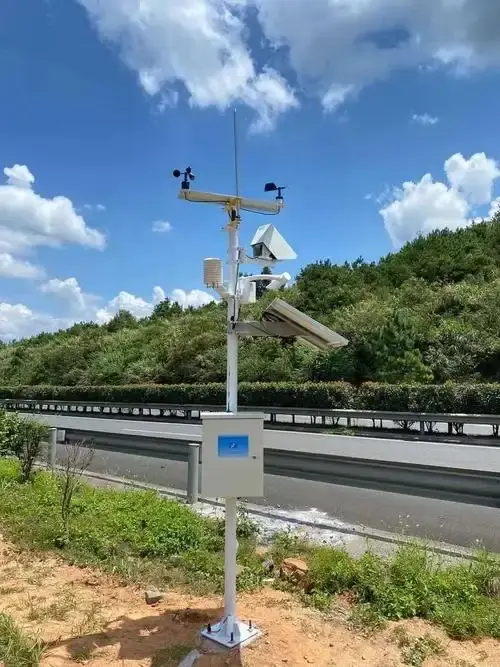
Road Weather Information Systems (RWIS) provide transportation departments (DOTs) with real-time pavement telemetry to guide chemical deicing, dynamic speed management, and winter maintenance logistics. For decades, deploying road sensors required embedding physical pucks directly inside the traveled asphalt.
However, modern highway asset managers increasingly transition to remote optical sensing. Learn how non-contact spectroscopy modernizes highway monitoring within our dedicated traffic and highway safety monitoring solutions.
1. The Hidden Costs of In-Pavement Puck Sensors
Traditional in-pavement sensors sit flush with or slightly below the roadway surface. While they provide direct physical contact with road brine, their mechanical lifecycle presents critical challenges:
- Costly Lane Closures & Traffic Control: Core-drilling asphalt requires closing active highway lanes, setting up attenuator trucks, and putting maintenance crews at risk from moving traffic.
- Destruction During Asphalt Resurfacing: When highways undergo routine milling and repaving every 7 to 10 years, embedded sensors and subsurface signal cables are obliterated, requiring complete replacement budgets.
- Snowplow Blade Impact: Heavy steel plow blades scraping snowpack exert extreme shearing loads that dislodge or crack surface-mounted epoxy housings.
2. Optical Working Principle of Non-Invasive Remote Sensors
Non-invasive sensors—such as the VT-RSS11E Non-Contact Road State Sensor—are mounted on roadside poles or overhead gantries, pointing down at an angle between 30° and 85° toward the wheel-track zone:
- Multispectral Infrared Absorption: Water, ice, and compacted snow exhibit distinct optical absorption signatures across short-wave and mid-wave infrared spectrums. By measuring reflected light ratios, the sensor differentiates dry asphalt, wet film, standing water, slush, and black ice.
- Pyrometric Surface Temperature: An integrated infrared radiometer measures the thermal radiation emitted by the pavement, calculating precise road surface temperature ($T_s$) without touching the road.
- Water & Ice Thickness: Advanced algorithms calculate the liquid water-film thickness (0 to 10 mm) and ice layer depth, computing real-time grip coefficient values ($mu = 0.10 \sim 0.82$).
3. Field Comparison: Non-Invasive vs. Embedded Sensors
When selecting road sensors for highway corridors or bridge decks, engineers benchmark the following key parameters:
- Installation Time: Remote sensors mount in under 60 minutes from a bucket truck parked on the shoulder, without halting highway lane flow.
- Site Survivability: Positioned 3 to 13 meters above the roadway, remote sensors are completely immune to snowplow strikes, studded tire wear, and heavy axle loading.
- Bridge Deck Thermal Expansion: Installing embedded pucks in concrete bridge decks risks structural cracking and moisture penetration into rebar structures, making non-invasive optical scanning the preferred choice.
4. System Integration into RWIS Outstations
Modern remote sensors stream data via RS485 Modbus-RTU or NTCIP protocols straight into road weather outstations and smart ITS platforms. For comprehensive guidance on roadside hardware architecture, read our buying guide on How to Select a Road Weather Station.
Conclusion
By eliminating asphalt cutting and traffic interruptions, non-invasive road sensors drastically reduce life-cycle OPEX while delivering millisecond-fast ice warnings. Contact the Virtue Instrument engineering team to review mounting angle calculations, roadside pole boom drawings, and field test evaluations for your upcoming transportation project.