
Mobile RWIS: Vehicle-Mounted Optical and Thermal Sensors for Real-Time Highway Winter Maintenance
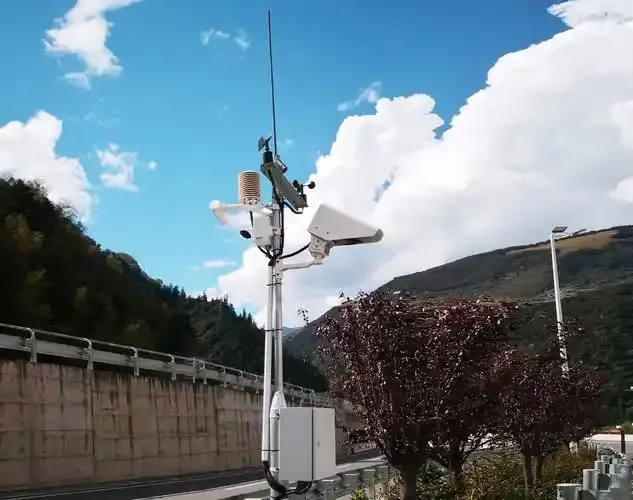
Fixed Road Weather Information Systems (RWIS) are the backbone of modern highway winter maintenance networks. However, stationary roadside towers leave massive blind spots; a 100-kilometer stretch of mountainous interstate might only have two fixed stations. Microclimates across mountain passes, river bridges, and forested cut-throughs can generate lethal black ice kilometers away from the nearest fixed probe.
Mobile RWIS bridges these critical gaps. By installing high-frequency optical, infrared, and atmospheric sensors onto existing highway patrol vehicles, supervisor pickups, and municipal salt spreaders, departments of transportation (DOTs) transform maintenance fleets into dynamic road-condition scanners. Explore these integrated highway fleets in our mobile and vehicle detection solutions.
1. The Anatomy of a Mobile RWIS Sensor Suite
A vehicle operating at 60 to 90 km/h covers up to 25 meters every single second. Stationary road sensors scanning every 60 seconds cannot function here; mobile instrumentation requires continuous 10Hz to 50Hz high-frequency telemetry. A complete mobile payload integrates three sensor subsystems:
- Non-Invasive Infrared Pavement Temperature Probes: High-precision thermopile sensors focused downward onto the asphalt measure infrared surface radiation ($8 ext{--}14 mu ext{m}$ band), isolating actual road skin temperature from ambient air temperature.
- Multi-Spectral Optical Surface State Spectrometers: Pulsed near-infrared (NIR) laser diodes measure the differential reflection spectrum of road surfaces to classify dry asphalt, wet film, slush, compacted snow, and transparent black ice.
- Roof-Mounted Vehicle Weather Arrays: Solid-state ultrasonic stations measuring ambient air temperature, barometric pressure, relative humidity, dew point, and dynamic true wind vectors.
2. Optical Detection: Liquid Film Thickness and Grip Coefficient ($mu$)
Water, ice, and hydrocarbons possess distinct absorption signatures in the near-infrared spectrum (specifically around $1430 ext{ nm}$ and $1940 ext{ nm}$). By emitting rapid, pulsed NIR beams onto the pavement and analyzing the backscattered intensity, mobile optical sensors compute:
- Water Layer Thickness ($0.00 ext{ to }2.00 ext{ mm}$): Critical for hydroplaning warnings and determining how quickly chemical brine will dilute.
- Ice Layer Thickness: Quantifying frost build-up down to $0.01 ext{ mm}$ thickness before human eyes can spot transparent glaze.
- Estimated Grip Friction Coefficient ($mu$): Rated from $0.82$ (bone-dry aggregate) down to $0.10$ (polished black ice). When friction drops below safe braking thresholds, automated alarms alert traffic management systems.
3. Automated Salt & De-Icer Dosage Optimization
Over-salting roadways wastes millions of dollars in chemical de-icers and leaches chloride ions into roadside wetlands and aquifers. Under-salting leaves highways impassable and creates multi-vehicle pileups.
When integrated into a snowplow's hydraulic spreader controller, mobile RWIS provides closed-loop chemical dosing:
$$ ext{Dosage Rate } (g/m^2) = f(T_{road}, Delta T_{dew_point}, ext{Layer Thickness}, mu)$$
If the vehicle crosses a dry bridge deck at $-3^circ ext{C}$ with dry conditions ($mu > 0.75$), the spreader automatically throttles off. As the truck enters a valley shadow where pavement temperature plunges below the freezing point and a $0.2 ext{ mm}$ damp film forms, the spreader instantly activates, applying targeted sodium chloride brine exactly where black ice is actively nucleating.
4. Ruggedization: Surviving Shock, Salt Fog, and Pavement Debris
Mounting delicate optical lenses near vehicle undercarriages exposes them to high-speed gravel impacts, relentless vibration (MIL-STD-810H), and caustic salt spray. Industrial mobile instruments incorporate heated sapphire front optics, pressurized aerodynamic air-curtain nozzles to divert wheel spray, and IP68-sealed hermetic enclosures.
Units like the roof-mounted VT-SA6E Compact Weather Array withstand constant highway wind drag and sub-zero blizzard environments without mechanical cup-and-vane failure points.
Conclusion
Mobile RWIS transforms highway winter management from reactive emergency response to predictive, surgically targeted maintenance. Contact Virtue Instrument to discuss mobile sensor integration for maintenance truck fleets, snowplows, and transit agency vehicles.