
Highway Visibility Sensors & Sudden Fog Detection: Automating VMS Speed Alerts to Prevent Multi-Car Pileups
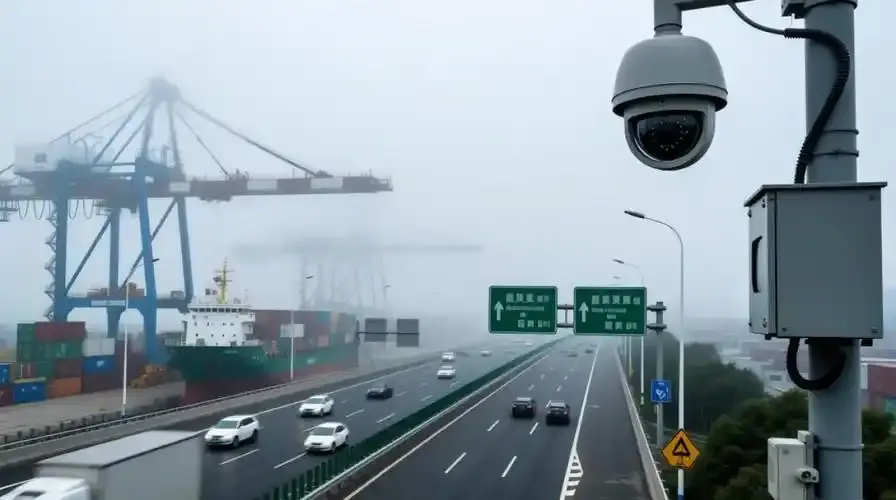
Dense, localized fog banks (often termed radiation or advection fog) represent one of the deadliest atmospheric hazards on high-speed motorways. Vehicles cruising at 110 km/h transition from clear conditions into blinding whiteout fog pockets within seconds, resulting in devastating multi-car chain collisions.
Mitigating this risk requires rapid, automated detection. Discover how forward-scatter optical sensors integrate within our intelligent highway safety monitoring systems to trigger real-time traveler warnings.
1. The Physics of Forward-Scatter Visibility Measurement
Transmissometers, while historically utilized on airport runways, require long optical baselines (10 to 50 meters) between separate transmitter and receiver towers, rendering them impractical for narrow highway shoulders.
Modern road authorities rely on compact forward-scatter visibility sensors, such as the VT-SLV2E-2 Visibility Sensor:
- Aerosol Scattering Angle: An infrared light-emitting diode (typically $\lambda = 880\text{ nm}$) pulses a calibrated optical beam. When water fog droplets or haze particles cross the sample volume, light scatters forward at an engineered angle of 35° to 45°.
- Meteorological Optical Range (MOR): A silicon photodiode receiver measures the scattered photon intensity, mathematically deriving the atmospheric extinction coefficient ($sigma$) and computing MOR from 10 meters up to 10,000 meters.
- For a foundational review of optical scatter physics, refer to our technical breakdown on Visibility Sensors: Optical Principles and Selection.
2. Closed-Loop Automation: Integrating Visibility Data with VMS & Traffic Control
Data latency is fatal during sudden fog events. Modern smart ITS architectures establish direct sensor-to-sign automation without waiting for manual human operator verification:
- Threshold Stage 1 ($MOR < 200\text{ m}$): The roadside visibility sensor transmits an automated alert over RS485 Modbus. The upstream Variable Message Sign (VMS) displays: "FOG AHEAD - REDUCE SPEED TO 80 KM/H".
- Threshold Stage 2 ($MOR < 50\text{ m}$): Severe hazard alert triggers. Overhead VMS drops mandatory variable speed limits (VSL) to 50 km/h and flashes roadside hazard beacons.
- Tunnel Entrance Safety: In tunnel approach zones, sudden daylight-to-dark transitions combined with external fog create catastrophic visual disorientation. Visibility sensors trigger approach lighting adaptations to balance entrance luminance.
3. Engineering for Harsh Roadside Environments: Self-Cleaning Optics
Positioned alongside multi-lane highways, optical sensors are continuously bombarded by oily diesel exhaust, wet tire spray, and corrosive road salts. Without proper design, optical lenses foul in weeks:
- Down-Look Optical Geometry: Transmitter and receiver hoods angle downward and feature deep hood cowls that shield optical windows from direct driving rain and splashback.
- Window Contamination Diagnostics: Internal reference beams continuously monitor dirt and dust accumulation on lens surfaces, automatically applying mathematical baseline compensation until threshold limits alert maintenance crews.
- Thermostatic Lens Dew Heaters: Continuous low-wattage heating prevents condensation, frost, and dew from forming on external optics during rapid morning temperature inversions.
Conclusion
Automated forward-scatter visibility monitoring bridges the gap between regional weather forecasts and rapid roadside hazard prevention. Contact our technical engineering team to request CAD mounting brackets, NTCIP communication profiles, and tunnel visibility specifications.